[et_pb_section fb_built=”1″ _builder_version=”3.10.1″ use_background_color_gradient=”on” background_color_gradient_start=”rgba(255,255,255,0.65)” background_color_gradient_end=”rgba(255,255,255,0.65)” background_color_gradient_overlays_image=”on” background_image=”https://wholefoodfor7.com/wp-content/uploads/2018/07/bg-pattern.png” background_size=”contain” background_repeat=”repeat”][et_pb_row _builder_version=”3.0.48″ background_size=”initial” background_position=”top_left” background_repeat=”repeat”][et_pb_column type=”4_4″ _builder_version=”3.0.47″ parallax=”off” parallax_method=”on”][et_pb_text admin_label=”title of recipe/post” _builder_version=”3.11″ header_font=”|||on|||||”]
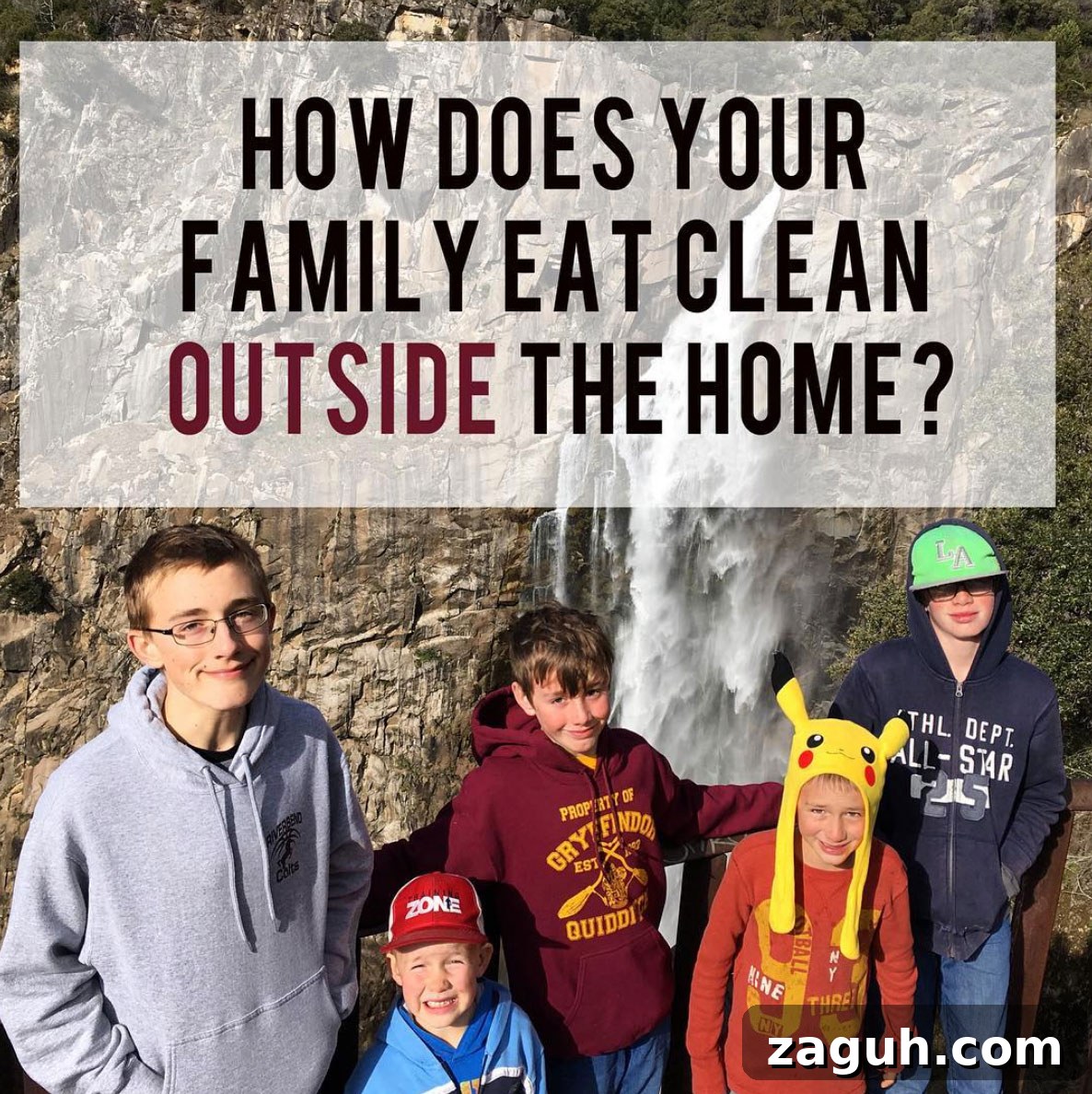
How Does Your Family Eat Clean Outside The Home?
[/et_pb_text][et_pb_image src=”https://wholefoodfor7.com/wp-content/uploads/2018/08/eat-clean.jpg” admin_label=”image of recipe” _builder_version=”3.11″][/et_pb_image][et_pb_text admin_label=”blog post or details about recipe” _builder_version=”3.11″]
Happy #minionmonday! I often get questions about how to maintain clean eating for your children when you’re away from home. Here’s how I handle it and some practical ideas you can adapt to your family.
First, my priority is controlling what happens inside our home. As the adult who shops and cooks, I focus my energy on keeping our pantry and fridge stocked with nourishing, whole foods. That’s where I can make the biggest, most consistent impact on my family’s daily eating habits.
I don’t try to micromanage every outside interaction. At school, for example, if a classmate brings cupcakes for a birthday, I leave the choice to my kids. These occasions are relatively rare and, for our family, not frequent or consequential enough to justify strict prohibition. Trying to control every third-party situation would be exhausting and could create power struggles or secretive habits.
Could I attempt stricter control? Yes. But I prefer to teach my children the principles of clean eating and give them tools to make good choices on their own. My oldest, at 14, follows a Paleo lifestyle consistently. My younger children are more flexible—they might accept a candy bar if offered. Still, I trust that the education and example we provide will guide their long-term habits. The goal is to empower them to choose healthy options because they understand the benefits, not because they’re forced.
Dealing with extended family can be more complicated. If grandparents or relatives frequently offer treats, it helps to communicate clearly and kindly why your family eats the way it does. I recommend explaining the reasons in a personal and specific way rather than only making a general statement. For example, saying “We eat this way because it helps reduce Graham’s fits, and sugar triggers them” gives context and can encourage cooperation. Framing the request around health, safety, or a specific concern is often more effective than presenting clean eating as merely a preference.
It’s also useful to set boundaries in advance when someone else will be caring for your children. Offer suggestions or bring suitable treats so guests have easy alternatives to offer. Keep conversations compassionate—remember that food often represents love and connection. Approaching the topic with appreciation and clarity will usually get better results than confrontation.
Ultimately, balance matters. Focus on the environment you control, teach your kids why you make the choices you do, and give them room to navigate occasional outside temptations. That combination builds lifelong habits without turning food into a battleground.
I’d love to hear how other families manage clean eating outside the home—what strategies have worked for you with schools, friends, or relatives?
[/et_pb_text][et_pb_post_nav in_same_term=”on” prev_text=”PREVIOUS POST” next_text=”NEXT POST” _builder_version=”3.11″][/et_pb_post_nav][/et_pb_column][/et_pb_row][/et_pb_section]